
Most founders think a pitch deck is about slides. It's not. It's about removing doubt.
After analyzing hundreds of successful funding rounds, I've noticed something: the decks that close consistently share a trait that has nothing to do with aesthetics. They layer validation signals so effectively that investors feel they're watching a train that's already left the station—and they need to get on board.
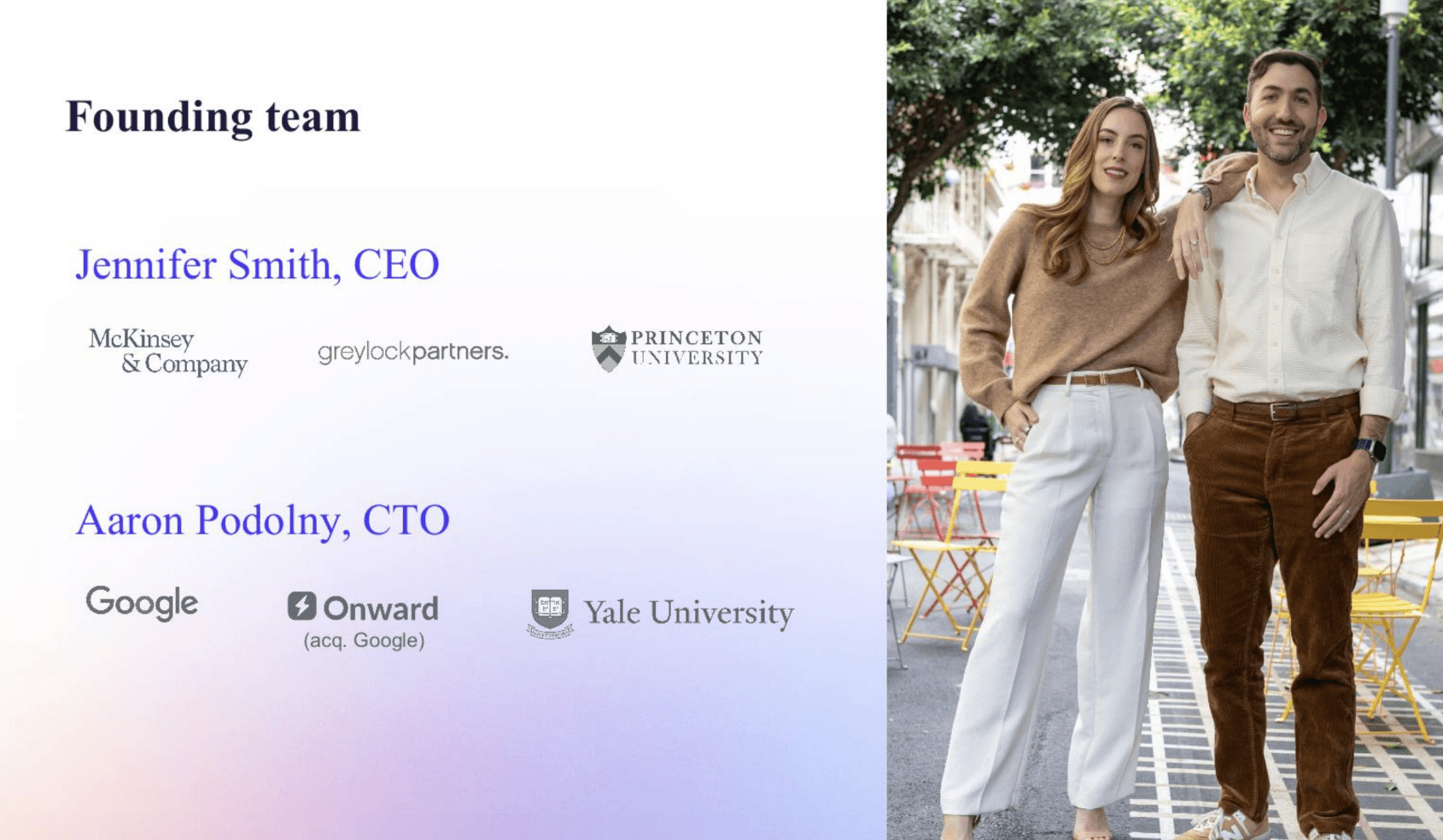
Scribe's recent $75 million Series C at a $1.3 billion valuation demonstrates this principle brilliantly. Their deck doesn't convince investors of an opportunity. It proves the opportunity already exists and is accelerating.
Click here to view the pitch deck >
Principle One: Show Momentum, Not Just Metrics
Here's what separates good decks from great ones: trajectory beats scale.
Five million users is impressive. But that number alone tells investors nothing about velocity. Are you growing 10% annually or 300%? Are you pulling users from incumbents or creating an entirely new behavior?
Scribe understood this. Rather than simply stating user count, they emphasized that 5 million users includes teams at 94% of Fortune 500 companies. This isn't just about volume—it's about market penetration at the highest level. When blue-chip enterprises are already using your product, you're not pitching potential. You're demonstrating reality.
The critical mistake I see founders make is showcasing cumulative growth without revealing the underlying pattern. A chart showing steady month-over-month increases tells a different story than one that flatlines or fluctuates wildly. Investors want to see a consistent upward trajectory because it suggests systematic, repeatable growth—not lucky timing or one-off wins.
Principle Two: Prove Competitive Advantage, Don't Just Claim It
"First-mover advantage" is one of the most abused phrases in startup pitches. Being first means nothing if someone else executes better.
What matters is demonstrable differentiation that creates real switching costs. Scribe positioned themselves not just as first to market, but as the only company with the data layer required to make enterprise AI actually work. They've documented over 10 million workflows across 40,000 applications. That's not a feature—that's a moat.
Think about what it would take for a competitor to replicate this. They'd need years of data collection, deep integration across tens of thousands of software tools, and proven workflows from the world's most sophisticated organizations. By the time anyone caught up, Scribe would be even further ahead.
The best decks make competitive threats seem almost irrelevant. Not because competition doesn't exist, but because the company has built structural advantages that compound over time.
Principle Three: Stack Validation Signals Relentlessly
This is where most founders leave money on the table.
You can't over-validate. Every additional proof point reduces investor risk and increases conviction. Scribe didn't stop at user growth. They added customer logos, testimonials, quantifiable impact metrics (35-42 hours saved per person monthly), onboarding efficiency gains (40% faster), and a top 1% Net Promoter Score.
Each validation type addresses a different concern:
Logos answer: "Who else believes in this?"
Testimonials answer: "What do users actually think?"
Usage metrics answer: "Is this generating real value?"
NPS answers: "Will customers stay and refer others?"
When you stack these signals, you create overwhelming evidence. Investors stop asking "will this work?" and start asking "can we get in?"
The Underlying Truth
Here's what nobody tells you: pitch decks don't create success. They document it. The founders who raise at premium valuations aren't better at PowerPoint. They're better at building businesses that generate undeniable proof points.
Scribe's deck worked because their business was working. They had viral bottom-up adoption, enterprise-wide deployment, quantifiable ROI, and a dataset that becomes more valuable as it grows. The deck just organized these facts into a compelling narrative.
Your job isn't to make a beautiful presentation. It's to build a business so strong that the deck almost writes itself. Focus on creating validation, not persuasion. Because when the proof is overwhelming, investors convince themselves.

